Where Our Work Began:
The Story of Orton, Gillingham, & Stillman
More than a century ago, three pioneers asked a question that changed the lives of generations of children:
What if children who struggle to read don’t need lower expectations—they need a different way of being taught?
That question became the beginning of the Orton-Gillingham approach.
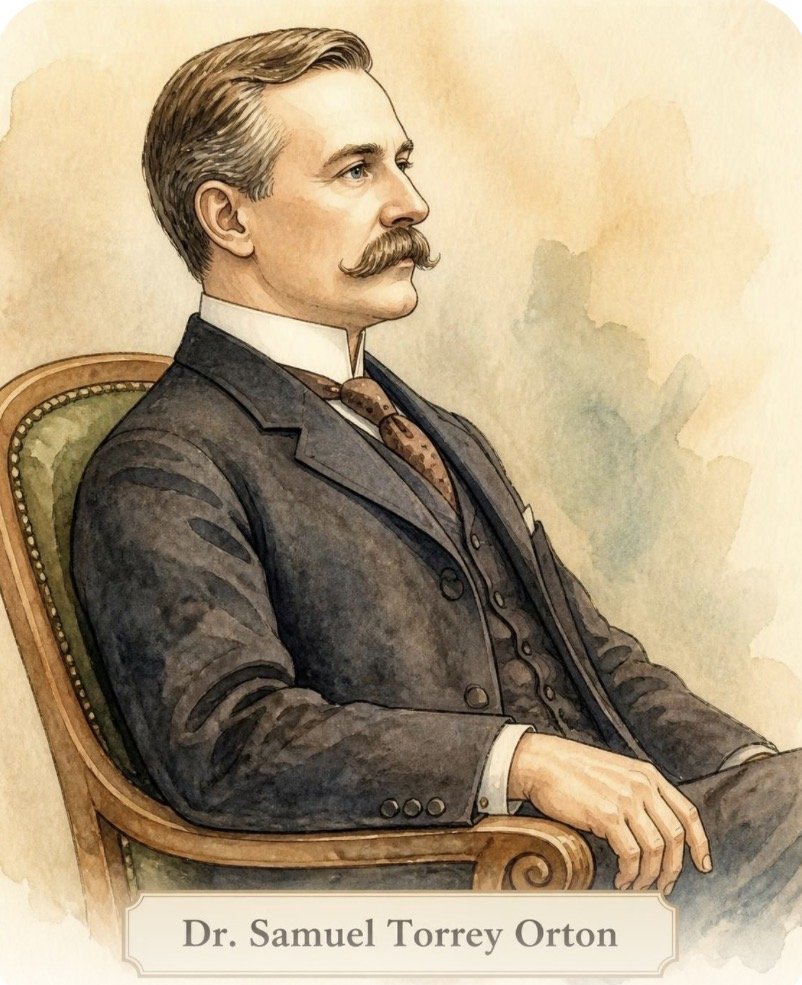
Dr. Samuel Torrey Orton (1879–1948)
Dr. Samuel Torrey Orton was a physician, neuropsychiatrist, and pathologist who became fascinated by children who struggled with reading despite having average or above-average intelligence. Through his medical work, he recognized similarities between the difficulties experienced by these children and the language difficulties seen in adults following brain injury.
At a time when struggling readers were often considered lazy, careless, or unintelligent, Dr. Orton saw something very different. He recognized that many of these children were bright and capable, but were having difficulty making sense of the written symbols of language. Through his research, Orton realized there was a neurological explanation for their difficulty with written language. He used the term “strephosymbolia,” meaning “twisted symbols,” to describe what he observed—a difficulty in connecting and organizing the symbols of written language.
Orton developed theories about the neurological basis of reading difficulties and became one of the earliest pioneers in the study of what we now call dyslexia. In 1925, Orton published important research on children with severe reading difficulties and called for instructional methods specifically designed around their needs. He believed that these students could learn to read and that instruction should engage multiple pathways to learning—including seeing, hearing, speaking, and writing. His work laid the neurological and educational foundation for what would become the Orton-Gillingham approach.
Most importantly, Orton believed that children with reading difficulties could learn when they were given instruction suited to the way they learned.
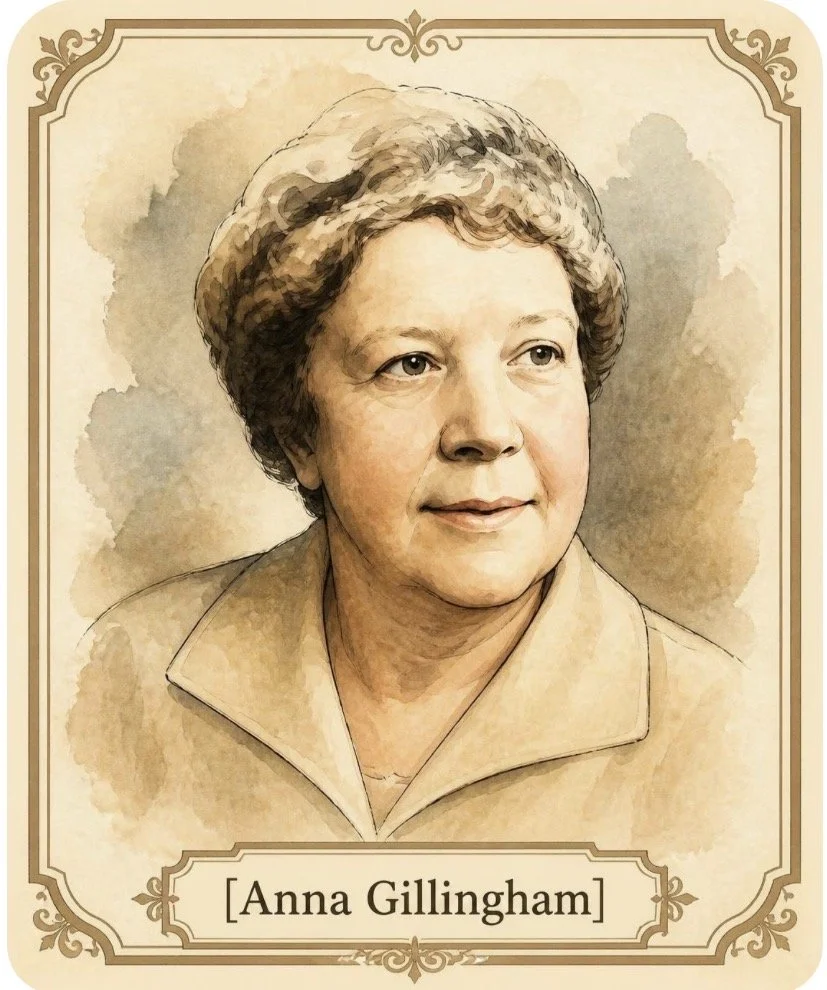
Anna Gillingham (1878–1963)
Anna Gillingham was an exceptional educator and psychologist with a deep understanding of the English language. She had already spent years working with children who struggled with reading and spelling when she began collaborating with Dr. Orton.
Gillingham took Orton’s ideas and helped turn them into a systematic, structured, sequential, and multisensory approach to teaching language. She worked closely with educator Bessie Stillman to organize instructional procedures and materials that teachers could use to explicitly teach children the structure of English. Their work emphasized teaching language explicitly, systematically, sequentially, and through multiple senses.
Gillingham understood something that remains at the heart of Orton-Gillingham instruction today: children should not be expected to guess their way into reading. They need to be explicitly taught how spoken language connects to written language, and they need sufficient practice to make those connections automatic.
Together, Orton, Gillingham, and Stillman developed instructional practices that incorporated visual, auditory, and kinesthetic learning—having students see, hear, say, and write the elements of language.
Their work eventually led to the publication of Remedial Training for Children with Specific Disability in Reading, Spelling and Penmanship, which became an important foundation for Orton-Gillingham teacher training and instruction.
Bessie Stillman (1871–1947)
Bessie Stillman (1871-1947) was an educator and contributor to the Orton-Gillingham teaching method for students with disabilities in reading.
Stillman was a teacher at the Ethical Culture School in New York when she met Anna Gillingham. She collaborated with Anna Gillingham to create a remedial program called "The Alphabetic Method," which taught phonemes, morphemes and spelling rules through multisensory techniques, which they published in 1936.
During this time (1935-1937) Stillman worked and studied with Gillingham at the Punahou School in Honolulu, Hawaii. There they adapted the Orton-Gillingham method for use in classrooms, translating Orton’s ideas into clear and practical instructional practices for teachers.
Bessie collaborated with Gillingham until her death in 1947.
A Legacy of Hope
The work of Orton, Gillingham, and Stillman was revolutionary because it began with a fundamental belief:
A child who struggles to read is not a child who cannot learn.
Their work helped change the conversation around reading difficulties—from blaming the child to understanding the child’s needs.
Today, Orton-Gillingham remains a structured, multisensory approach designed to teach the patterns and structure of the English language explicitly and systematically.
At the Orton-Gillingham Dyslexia Center, we carry that legacy forward.
We believe children with dyslexia deserve teachers who understand how they learn. They deserve instruction that is carefully structured, individualized, and based on the child’s needs. And they deserve to experience the confidence that comes when something that once seemed impossible finally makes sense.
More than 80 years after Orton’s death and more than 60 years after Gillingham’s, their belief continues to guide us:
Every child can learn to read.
Sometimes, they simply need to be taught differently.
A Brief History
1920s — Dr. Samuel Orton begins his pioneering research
Orton studies children with severe reading difficulties and begins developing theories about the neurological basis of dyslexia.
1925 — Orton publishes important research on reading difficulties
His work challenges prevailing assumptions about children who struggle to read and emphasizes the need for specialized instruction.
1930s — Orton and Gillingham collaborate
Anna Gillingham works with Orton to develop practical instructional methods based on his research.
1930s–1940s — Gillingham and Bessie Stillman organize the method
Their work establishes systematic procedures for teaching reading, spelling, and written language through multisensory instruction.
Today — The legacy continues
Orton-Gillingham has become one of the foundational approaches used to provide structured literacy instruction to students with dyslexia and other language-based learning difficulties.
From Their Work to Ours
Orton saw the child.
Gillingham built the method.
Stillman helped organize the instruction.
And generations of teachers have carried their work forward.
We are honored to be part of that legacy.
We’re in the process of becoming an accredited instructional program of the Orton-Gillingham Academy.