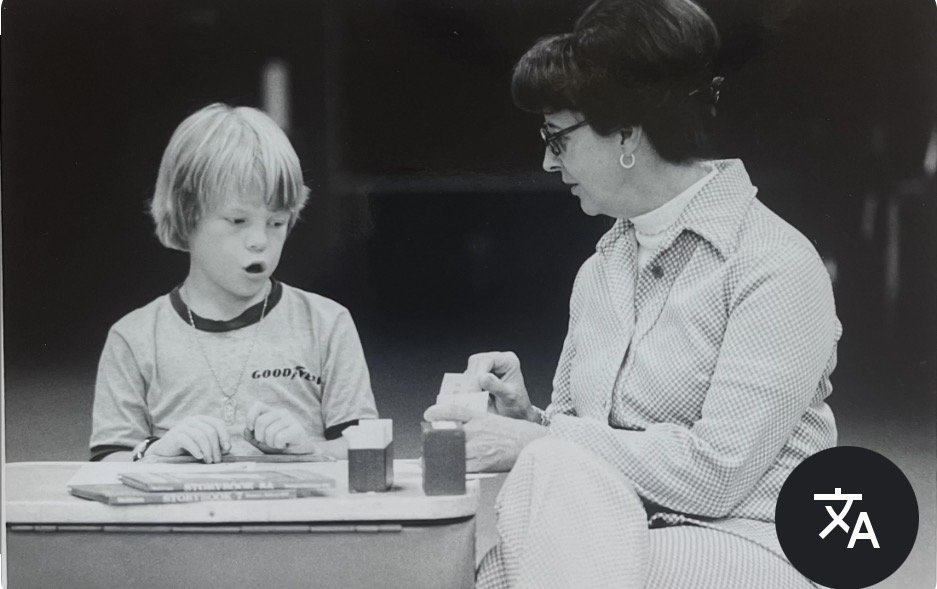
The Orton-Gillingham Dyslexia Center Story:
It was a dark and stormy night!
The Orton-Gillingham (O-G) Approach was in jeopardy. The organization dedicated to O-G tutoring was changing course, and at least two people were very concerned about where that course was headed.
Jennifer Pultz and Dr. Michael Sullivan were determined to maintain the fidelity of what they believed was the gold standard in dyslexia instruction: the Orton-Gillingham Approach.
They reached out to other concerned O-G tutors, and together, they decided to take matters into their own hands.
Thus, the Orton-Gillingham Dyslexia Center (OGDC) was born.
The goal was simple:
Do not let Orton-Gillingham die.
And they had followers, too.
Seven of them.
They began their work around a folding table in the basement of a local church, armed with determination, teaching materials, ideas, and a handful of passionate volunteers. What they lacked in numbers, they made up for in conviction.
Slowly, the pieces began to fall into place. The organization received its 501(c)(3) status. A website was built. A permanent location was secured. Students began to find their way to the Center, where they found Orton-Gillingham Academy trained tutors to help them on their dyslexia journey.
But OGDC is about more than tutoring.
Why Fidelity Matters
Orton-Gillingham is not simply a collection of activities or a curriculum that can be packaged and sold. It is a structured, diagnostic, prescriptive, multisensory approach that requires extensive training, supervised practicum, and experience to deliver well.
Training through the Orton-Gillingham Academy (OGA) represents a rigorous pathway for practitioners committed to maintaining the integrity of the Approach. OGA training involves substantial coursework and supervised practicum, with advanced levels requiring significant experience and observation.
There are many dyslexia programs available today—including Barton, Launch Literacy, Take Flight, and others—that incorporate principles derived from Orton-Gillingham. But having O-G–based activities is not necessarily the same thing as having a practitioner who has been thoroughly trained in the Orton-Gillingham Approach.
Fidelity matters. Training matters. Experience matters.
Children with dyslexia deserve intervention delivered by people who understand not only what to teach, but why, when, and how to adjust instruction based on the individual child.
They have already struggled enough.
The last thing we want is for a child to experience failure again because the intervention they received was not delivered with the knowledge, training, and fidelity necessary to meet their needs.
It is important not to traumatize a child twice.
Every great movement starts with a few people who are willing to stand up for what they believe.
This is ours.
Where Our Work Began
The Story of Orton, Gillingham & Stillman
More than a century ago, two pioneers asked a question that changed the lives of generations of children:
What if children who struggle to read don’t need lower expectations—they need a different way of being taught?
That question became the beginning of the Orton-Gillingham approach.
Dr. Samuel Torrey Orton
Dr. Samuel Torrey Orton (1879–1948) was a physician and neuropsychiatrist who devoted much of his career to understanding children with severe reading difficulties.
At a time when struggling readers were often considered lazy, careless, or unintelligent, Dr. Orton saw something very different. He recognized that many of these children were bright and capable, but were having difficulty making sense of the written symbols of language.
Through his research, Orton developed theories about the neurological basis of reading difficulties and became one of the earliest pioneers in the study of what we now call dyslexia.
He believed that instruction should take advantage of multiple pathways to learning. Rather than simply asking children to memorize words, he emphasized connecting what they see, hear, say, and write.
Most importantly, Orton believed that children with reading difficulties could learn when they were given instruction suited to the way they learned.
Anna Gillingham
Anna Gillingham (1878–1963) was an educator and psychologist who brought exceptional knowledge of language, spelling, and teaching to Orton’s work.
Gillingham took Orton’s theories and helped translate them into practical instruction that teachers could use with children.
Working with Bessie Stillman, Gillingham organized and systematized lessons for teaching the structure of English. Their work emphasized teaching language explicitly, systematically, sequentially, and through multiple senses.
Instead of asking a struggling reader to guess at a word, the teacher helps the child understand why the word is spelled and read the way it is.
Children learn to connect sounds, letters, symbols, words, and language patterns through seeing, hearing, speaking, moving, and writing.
This became the foundation of what we now know as the Orton-Gillingham approach.
A Legacy of Hope
The work of Orton, Gillingham, and Stillman was revolutionary because it began with a fundamental belief:
A child who struggles to read is not a child who cannot learn.
Their work helped change the conversation around reading difficulties—from blaming the child to understanding the child’s needs.
Today, Orton-Gillingham remains a structured, multisensory approach designed to teach the patterns and structure of the English language explicitly and systematically.
At the Orton-Gillingham Dyslexia Center, we carry that legacy forward.
We believe children with dyslexia deserve teachers who understand how they learn. They deserve instruction that is carefully structured, individualized, and based on the child’s needs. And they deserve to experience the confidence that comes when something that once seemed impossible finally makes sense.
More than 80 years after Orton’s death and more than 60 years after Gillingham’s, their belief continues to guide us:
Every child can learn to read.
Sometimes, they simply need to be taught differently.
A Brief History
1920s — Dr. Samuel Orton begins his pioneering research
Orton studies children with severe reading difficulties and begins developing theories about the neurological basis of dyslexia.
1925 — Orton publishes important research on reading difficulties
His work challenges prevailing assumptions about children who struggle to read and emphasizes the need for specialized instruction.
1930s — Orton and Gillingham collaborate
Anna Gillingham works with Orton to develop practical instructional methods based on his research.
1930s–1940s — Gillingham and Bessie Stillman organize the method
Their work establishes systematic procedures for teaching reading, spelling, and written language through multisensory instruction.
Today — The legacy continues
Orton-Gillingham has become one of the foundational approaches used to provide structured literacy instruction to students with dyslexia and other language-based learning difficulties.
From Their Work to Ours
Orton saw the child.
Gillingham built the method.
Stillman helped organize the instruction.
And generations of teachers have carried their work forward.
We are honored to be part of that legacy.
We’re in the process of becoming an accredited instructional program of the Orton-Gillingham Academy.
The Founders of Orton-Gillingham
Dr. Samuel Torrey Orton & Anna Gillingham
The Orton-Gillingham approach has its roots in the pioneering work of two remarkable people: Dr. Samuel Torrey Orton, a physician and neuropsychiatrist, and Anna Gillingham, an educator and psychologist. Beginning in the 1920s and 1930s, they changed the way the world understood children who struggled to learn to read.
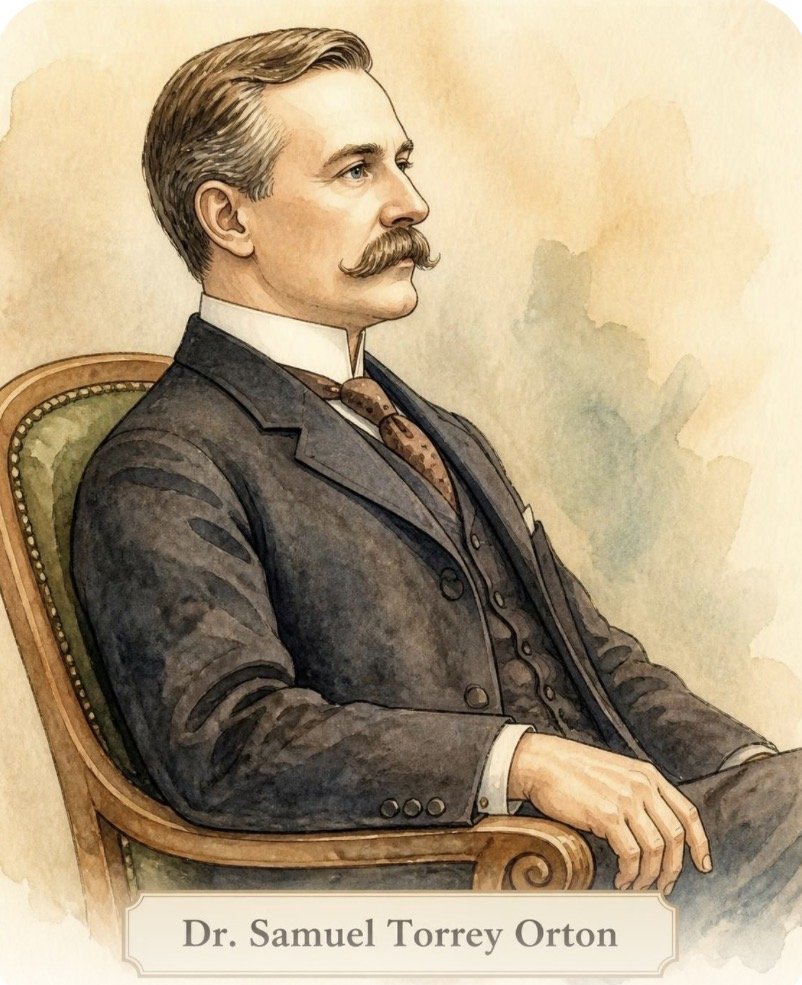
Dr. Samuel Torrey Orton (1879–1948)
Dr. Samuel Orton was a physician, neuropsychiatrist, and pathologist who became fascinated by children who struggled with reading despite having average or above-average intelligence. Through his medical work, he recognized similarities between the difficulties experienced by these children and the language difficulties seen in adults following brain injury.
Rather than believing that these children lacked intelligence or simply weren’t trying hard enough, Orton believed there was a neurological explanation for their difficulty with written language. He used the term “strephosymbolia,” meaning “twisted symbols,” to describe what he observed—a difficulty in connecting and organizing the symbols of written language.
In 1925, Orton published important research on children with severe reading difficulties and called for instructional methods specifically designed around their needs. He believed that these students could learn to read and that instruction should engage multiple pathways to learning—including seeing, hearing, speaking, and writing.
His work laid the neurological and educational foundation for what would become the Orton-Gillingham approach.
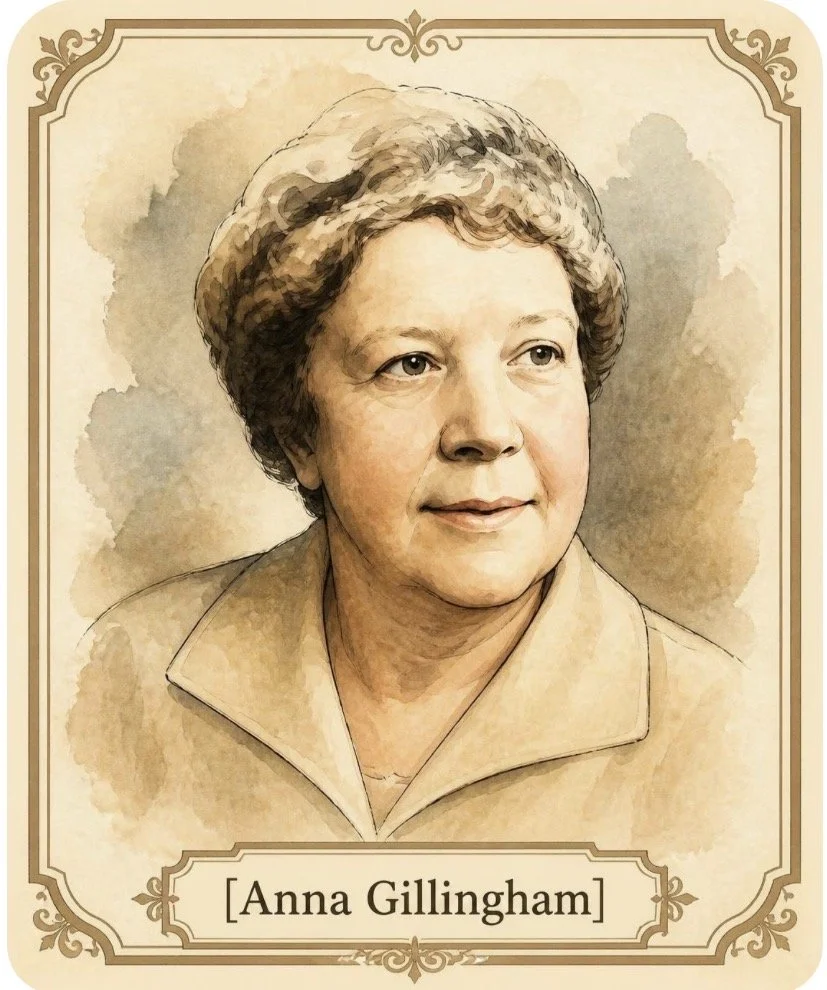
Anna Gillingham (1878–1963)
Anna Gillingham was an exceptional educator and psychologist with a deep understanding of the English language. She had already spent years working with children who struggled with reading and spelling when she began collaborating with Dr. Orton.
Gillingham took Orton’s ideas and helped turn them into a systematic, structured, sequential, and multisensory approach to teaching language. She worked closely with educator Bessie Stillman to organize instructional procedures and materials that teachers could use to explicitly teach children the structure of English.
Gillingham understood something that remains at the heart of Orton-Gillingham instruction today: children should not be expected to guess their way into reading. They need to be explicitly taught how spoken language connects to written language, and they need sufficient practice to make those connections automatic.
Together, Orton, Gillingham, and Stillman developed instructional practices that incorporated visual, auditory, and kinesthetic learning—having students see, hear, say, and write the elements of language.
Their work eventually led to the publication of Remedial Training for Children with Specific Disability in Reading, Spelling and Penmanship, which became an important foundation for Orton-Gillingham teacher training and instruction.
A Legacy That Continues Today
Orton and Gillingham believed that students with dyslexia were capable learners who needed the right kind of instruction—not lower expectations.
That belief remains at the heart of Orton-Gillingham today.
The approach they pioneered is direct, explicit, multisensory, structured, sequential, diagnostic, and prescriptive, with instruction tailored to the individual learner. (Orton-Gillingham Academy)
At the Orton-Gillingham Dyslexia Center, we are proud to carry forward their legacy. We believe every child deserves to understand how language works, to experience success as a reader, and to discover the confidence and joy that come from learning to read.
Their work began with a simple but powerful belief: struggling readers can learn. Our work continues that mission.
The Dorothy Blosser Whitehead Legacy
Our center honors Dorothy Blosser Whitehead, an early advocate for Orton-Giliingham dyslexia tutoring in the state of Oregon. She was internationally known for her tireless work in ensuring students with dyslexia receive the best remedial instruction,
When Dorothy started her teaching journey in the 1960s, she realized she did not know how to teach reading. She sought help from an Orton-Gillingham trainer who changed the course of her career. From there she would go on to found Language Skills Therapy, The Blosser Center, and the Orton-Gillingham Academy.